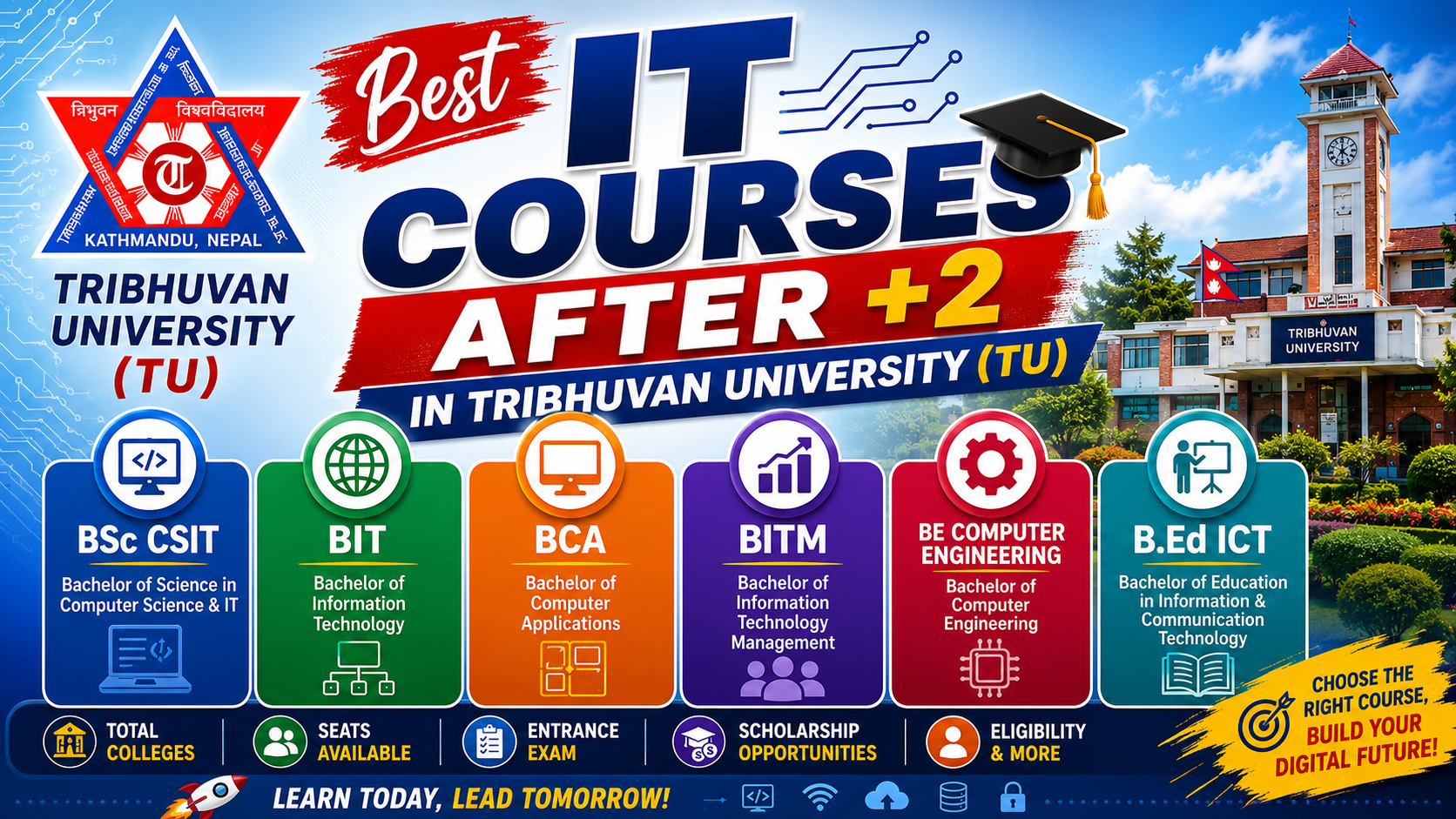
Nepal’s IT sector is growing faster than ever, and a bachelor’s degree in IT from Tribhuvan University is one of the most practical investments you can make after completing your +2. Whether you come from a science background or a management stream, whether your interest is coding, networking, business, engineering, or teaching — there is a TU IT program designed for you. This guide covers all six IT-related programs under TU with verified details on syllabus, entrance exams, seats, scholarships, and career scope so you can make the right choice.
Why Study IT in Nepal?
Nepal’s IT sector has grown rapidly, with software exports and outsourcing revenue increasing year after year. Companies like Leapfrog Technology, Cotiviti, Deerwalk, F1Soft, Fusemachines, and hundreds of startups are actively hiring fresh graduates. Beyond Nepal, thousands of Nepali IT professionals work remotely for companies in the US, Europe, and Australia.
Tribhuvan University is Nepal’s largest university and the most widely recognized for IT degrees by both local employers and foreign universities for higher studies.
Quick Course Comparison
Tribhuvan University offers six IT-related bachelor’s degree programs across different faculties. Each course has a different focus, entry requirement, and career path. The table below gives you a quick overview so you can identify which programs match your academic background and goals before reading the detailed sections.
| Course | Full Form | Duration | Faculty | Stream Needed | Entrance |
|---|---|---|---|---|---|
| BSc CSIT | B.Sc. Computer Science & IT | 4 yrs · 8 sems | IOST, TU | Science only | TU IOST Entrance |
| BIT | Bachelor of Information Technology | 4 yrs · 8 sems | IOST, TU | Any (Math/CS in +2) | TU IOST BIT Entrance |
| BITM | B. of Information Technology Management | 4 yrs · 8 sems | FOM, TU | Any stream | CMAT (TU FOM) |
| BCA | Bachelor of Computer Applications | 4 yrs · 8 sems | FOHSS, TU | Any stream | TU FOHSS BCA Entrance |
| BE (Computer) | Bachelor of Engineering — Computer | 4 yrs · 8 sems | IOE, TU | Science only | IOE Entrance (CBT) |
| B.Ed. ICT | Bachelor of Education — ICT | 4 yrs · 8 sems | FoE, TU | Any stream | TU FoE Entrance |
BSc CSIT — Bachelor of Science in Computer Science and Information Technology
BSc CSIT at a Glance
Seats & Availability
Government campuses have around 36 to 144 seats per campus depending on the campus. Private colleges have around 36 to 48 seats per college.
Eligibility
- Completed +2 in Science stream — Physical Group or Biology Group
- Physics and Mathematics mandatory (100 marks each) in Grades 11 and 12
- Minimum Grade C in all subjects
- Must pass the TU IOST entrance examination
Entrance Examination ✓ Verified 2025–26
Scholarships
- TU Merit Scholarship: 2 full scholarships per college — 1 male, 1 female — awarded to top entrance scorers.
- 10% scholarship quota: TU recommends 10% of total seats in affiliated colleges be reserved for scholarships.
- Constituent campus: Government campuses charge NPR 3–4 lakhs total and reserve 20% seats for students who studied Grade 8–12 in government/community schools.
Semester-wise Syllabus ✓ Verified from TU IOST
- CSC109Introduction to Information Technology
- CSC110C Programming
- CSC111Digital Logic
- MTH112Mathematics I
- PHY113Physics
- CSC160Discrete Structure
- CSC161Object-Oriented Programming
- CSC162Microprocessor
- MTH163Mathematics II
- STA164Statistics I
- CSC206Data Structure and Algorithm
- CSC207Numerical Method
- CSC208Computer Architecture
- CSC209Computer Graphics
- STA210Statistics II
- CSC257Theory of Computation
- CSC258Computer Networks
- CSC259Operating Systems
- CSC260Database Management System
- CSC261Artificial Intelligence
- CSC314Design and Analysis of Algorithms
- CSC315System Analysis and Design
- CSC316Cryptography
- CSC317Simulation and Modeling
- CSC318Web Technology
- Elective I (choose 1)
- CSC364Software Engineering
- CSC365Compiler Design and Construction
- CSC366Distributed System
- CSC367Advanced Java Programming
- Elective II (choose 1)
- Project I
- CSC410Software Project Management
- CSC411Internship (6 weeks)
- Elective III (choose 1)
- Elective IV (choose 1)
- Project II
- Elective V (choose 1)
- Elective VI (choose 1)
- Major Project
Assessment: Theory — 80 external + 20 internal (pass mark 35% each). Lab/practical — 60 external + 20 internal (pass mark 50% each independently).
Career Opportunities
- Software developer / backend engineer
- Data scientist and ML engineer
- DevOps and cloud engineer
- Full-stack web developer
- Cybersecurity researcher
- University lecturer (with further study)
Advantages
- Most technically respected IT degree in Nepal
- IOST runs exams on schedule — less delay
- Strong electives from Semester V
- Excellent for master’s abroad
- Biology stream also eligible (with Physics + Math)
Limitations
- Science stream only
- Heavy math in early semesters
- Competitive entrance exam
- Higher fees at private colleges
BIT — Bachelor of Information Technology
BIT at a Glance
What is BIT?
BIT is the practical middle ground of IT education in Nepal. While CSIT is theory-heavy, BIT focuses on applying IT in real environments — managing networks, securing systems, and integrating hardware and software. It is open to students from any +2 stream provided they studied Mathematics or Computer Science as a 100-mark subject.
Seats & Availability
BIT is currently offered only at government constituent campuses under TU IOST. There are no private affiliated colleges offering BIT under TU. Patan Multiple Campus and Bhaktapur Multiple Campus have around 72 seats each; all remaining campuses have around 36 seats each.
Eligibility
- Completed +2 from any stream — Science, Management, or Humanities
- Must have studied Mathematics (100 marks) or Computer Science (100 marks) in +2
- Minimum Grade C in English and at least one of Math or CS
- Must pass the TU IOST BIT entrance examination
Entrance Examination ✓ Verified 2025–26
If you studied Mathematics or Computer Science as a full 100-mark subject in +2, you are eligible for BIT from any stream. You choose which subject to be tested on in the entrance exam.
Scholarships
- Scholarship provisions follow TU IOST guidelines — merit and reservation categories are included in admission notices.
- Government constituent campuses offer significantly lower fees (NPR 3–4 lakhs total) with reserved seats.
- Private colleges offer partial scholarships based on entrance rank — confirm individually with each college.
Semester-wise Syllabus ✓ Verified from TU IOST
- Mathematics I
- Fundamentals of Information System
- Technical Communicative English
- Basic Electrical System and Circuits
- Principles of Management
- Programming in C · Project I
- Mathematics II
- Electronics Devices and Circuits
- Digital Logic
- Object-Oriented Programming in C++
- Financial Management and Accounting
- Project II
- System Analysis and Design
- Numerical Methods
- User Interface Design
- Microprocessor and Assembly Language
- Data Structure and Algorithms
- Project III
- Computer Architecture
- Database Management System
- Principle of Electronic Communication
- Operating System
- Marketing Management
- Project IV
- Probability and Statistics
- Data Communication
- Society and Ethics in IT
- Computer Graphics
- Operating System (Advanced)
- Project V
- Computer Network and Telecommunication
- Embedded System Programming
- Data Mining and Data Warehousing
- Management Information System
- Web Technology and Programming
- Project VI
- Network Programming
- Software Engineering
- Multimedia System and Communication
- Distributed Processing
- Artificial Intelligence
- Elective I
- Project Management
- E-Commerce
- Wireless Communication System
- Elective II
- Project VII (Major)
BIT includes 7 project works across all semesters, giving students significant hands-on experience throughout the degree.
Career Opportunities
- Network administrator and systems engineer
- Web developer (front-end and back-end)
- Cybersecurity analyst
- Database administrator
- IT project coordinator
- Embedded systems developer
Advantages
- Open to all streams (not just science)
- IOST-affiliated — regular exams, less delay
- Strong networking, security, and hardware focus
- 7 project works — strong practical experience
Limitations
- Only at govt campuses — no private colleges for TU BIT
- Less theoretical depth than CSIT
- Requires Math or CS in +2
BITM — Bachelor of Information Technology Management
BITM at a Glance
TU officially renamed BIM (Bachelor of Information Management) to BITM (Bachelor of Information Technology Management) from the 2082/083 academic session. Older enrolled batches continue under the BIM name — both BIM and BITM exam notices are published simultaneously by TU FOM.
Seats & Availability
Most colleges have around 66 seats (2 sections of 33) or around 33 seats (1 section). Each section has 30 regular + 3 mandatory scholarship seats.
Eligibility
- Completed +2 from any stream — Science, Management, Humanities, or Education
- Minimum Grade D in each theory subject with CGPA 1.8 or more, OR second division in 10+2/PCL
- No specific Math requirement
- Must pass the CMAT (Central Management Admission Test)
Entrance — CMAT ✓ Verified 2025–26
Scholarships ✓ Verified
- Mandatory 10% scholarship per section: Each section of 33 students has 3 mandatory scholarship seats (30 regular + 3 scholarship).
- 50% fee waiver: 2 students per section receive a 50% scholarship on the total fee collected by the college.
- Priority: Students who completed SEE/SLC and +2 from Nepalese government or community schools are given first priority.
Semester-wise Syllabus ✓ Verified from TU FOM (BIM curriculum)
- Principles of Management
- English Composition
- Basic Mathematics
- Computer Information System
- Digital Logic
- Sociology for Business
- Discrete Mathematics and Its Application
- Business Communication
- Structured Programming
- Data Communication & Computer Network
- Financial Accounting
- Web Programming I
- Java Programming I
- Computer Organization
- Business Statistics
- Cost and Management Accounting
- Microeconomics
- Data Structure and Algorithm with Java
- Web Technology II
- Database Management System
- Fundamentals of Marketing
- Macro Economics
- Computer Graphics
- Java Programming II
- Advanced Internetworking
- Business Finance
- Human Resource Management
- Business Environment
- System Analysis and Design
- Advanced Database Management
- E-Commerce
- Software Engineering
- IT Project Management
- Business Intelligence
- Project Work
- Information Security
- Enterprise Resource Planning
- Elective I (choose 1)
- Elective II (choose 1)
- Internship / Major Project
Note: The BITM curriculum for new batches (2082/083 onward) has been updated. The above reflects the BIM curriculum used by current batches. Verify the latest BITM syllabus from tudoms.org or fomecd.edu.np.
Career Opportunities
- IT project manager
- Business analyst
- ERP consultant
- Web developer
- IT consultant for banks and financial institutions
- Digital marketing specialist (IT focus)
Advantages
- Open to all streams
- Good combination of IT and business
- Strong for banking, finance, and corporate IT
- Mandatory 10% scholarship per section
Limitations
- Less technical depth than CSIT or BIT
- Not preferred for pure software development
- Management faculty — some exam delays historically
BCA — Bachelor of Computer Applications
BCA at a Glance
What is BCA?
BCA under TU’s FOHSS is one of the most popular IT degrees in Nepal. Students from any +2 stream can apply, and with 129 affiliated colleges it is the most geographically accessible IT degree in Nepal. The new 2025 curriculum has been significantly updated with modern subjects like Python Programming, Cryptography and Network Security, Cyber Security and Ethical Hacking, AI, Machine Learning, and IoT.
Seats & Availability
Most government campuses have around 70 seats; some have around 35 seats. Each private affiliated college has around 35 seats.
Eligibility
- Completed +2 from any stream — Science, Management, Humanities, or Education
- Minimum D+ grade in each subject of Grades 11 and 12 with CGPA 1.8 or more
- Students awaiting Grade 12 results may also apply
- Must pass the TU FOHSS BCA entrance examination
Entrance Examination ✓ Verified 2025–26
Scholarships
- Government constituent campuses charge NPR 2–3 lakhs total (4 years) — the most accessible scholarship option for BCA.
- Semester topper scholarships: Many colleges waive that semester’s tuition fee for the highest-scoring student each semester.
- Government school quota: Students from government/community schools may qualify for reserved or discounted seats at constituent campuses.
Semester-wise Syllabus ✓ Official New Syllabus 2025 — Verified from TU portal
- BCA 101Computer Fundamentals & Applications
- BCA 102Programming in C
- BCA 103Digital Logic
- BCA 104Mathematics-I
- BCA 105Professional Communication and Ethics
- BCA 106Hardware Workshop
- BCA 151Discrete Structure
- BCA 152Microprocessor and Computer Architecture
- BCA 153OOP in Java
- BCA 154Mathematics-II
- BCA 155UX/UI Design
- BCA 156Principle of Management
- BCA 201Data Structure and Algorithms
- BCA 202Database Management System
- BCA 203Web Technology-I
- BCA 204System Analysis and Design
- BCA 205Probability and Statistics
- BCA 206Applied Economics
- BCA 251Operating Systems
- BCA 252Software Engineering
- BCA 253Numerical Methods
- BCA 254Python Programming
- BCA 255Web Technology-II
- BCA 256Project-I
- BCA 301Computer Network
- BCA 302Artificial Intelligence
- BCA 303Advance Java Programming
- BCA 304MIS and e-Business
- BCA 305Society and Technology
- BCA 306Project-II
- BCA 351Computer Graphics and Animation
- BCA 352Mobile Programming
- BCA 353Cryptography and Network Security
- BCA 354Technical Writing
- BCA 355Distributed System
- BCA 356Project-III
- BCA 401Cyber Security and Ethical Hacking
- BCA 402Software Project Management
- BCA 403Financial Accounting
- BCA 404Project-IV
- BCA 405Elective-I (choose 1)
- BCA 406Elective-II (choose 1)
- BCA 451Cloud Computing
- BCA 452Internship
- BCA 453Elective-III (choose 1)
- BCA 454Elective-IV (choose 1)
Languages taught: C, Java, Python, JavaScript, PHP, SQL, .NET basics | Projects: 4 projects across the degree (Semesters IV, V, VI, VII) + Internship in Semester VIII
Career Opportunities
- Software developer (web and desktop apps)
- Android / iOS app developer
- Front-end and back-end web developer
- Cybersecurity analyst
- Database developer / administrator
- Freelance developer
- ML / AI developer (with elective)
Advantages
- Open to all +2 streams
- 129+ colleges — most accessible geographically
- New 2025 syllabus: AI, ML, Cybersecurity, IoT added
- 4 projects + internship build strong portfolio
- Affordable fees
Limitations
- FOHSS — history of exam delays (improving)
- Less theoretical depth than CSIT
- Electives only from Semester VII
- Requires strong self-study discipline
Bachelor of Computer Engineering (BE)
BE Computer Engineering at a Glance
Seats & Availability
Each college has around 48 seats. Government constituent campuses (Pulchowk, Thapathali, Pashchimanchal, Purwanchal) are the most competitive and prestigious.
Eligibility
- Completed +2 in Science stream with Physics, Chemistry, and Mathematics
- Minimum Grade C in each of Physics, Chemistry, and Mathematics with 45% aggregate
- Must pass the IOE national entrance exam (CBT)
Entrance Examination ✓ Verified 2025–26
Wrong answer on a 1-mark question deducts 0.1 marks; on a 2-mark question, 0.2 marks. CSIT, BIT, BCA, CMAT (BITM), and B.Ed. ICT entrance exams do NOT have negative marking. Do not guess randomly.
Scholarships
- Government scholarships: Full scholarships to top-ranked IOE entrance scorers at constituent campuses (Pulchowk, Thapathali, Pashchimanchal).
- Constituent campus fees: NPR 4–6 lakhs total — significantly lower than private colleges (NPR 14–25 lakhs).
- Reserved category seats: For Dalit, Janajati, and marginalized communities per government policy.
Semester-wise Syllabus ✓ Verified from IOE, TU
- Engineering Mathematics I
- Engineering Physics
- Engineering Chemistry
- Basic Electrical Engineering
- Engineering Drawing I
- Computer Programming in C
- Engineering Mathematics II
- Engineering Physics / Chemistry (alternate)
- Digital Logic
- Object-Oriented Programming
- Electronics Engineering
- Workshop Technology
- Engineering Mathematics III
- Data Structure and Algorithm
- Discrete Structure
- Computer Organization and Architecture
- Probability and Statistics
- Electrical Circuits and Machines
- Theory of Computation
- Microprocessor
- Operating System
- Numerical Methods
- Communication English
- Computer Network
- Design and Analysis of Algorithms
- Database Management System
- Software Engineering
- Computer Graphics
- Artificial Intelligence
- Minor Project
- Compiler Design
- Distributed System
- Embedded System
- Technical Writing and Communication
- Simulation and Modelling
- Elective I
- Information Systems
- Internet and Intranet
- Advanced Java Programming
- Elective II
- Elective III
- Major Project Part I
- Project Management
- Engineering Economics
- Elective IV
- Elective V
- Major Project Part II
Career Opportunities
- Software engineer (highest-paying track)
- Hardware and embedded systems engineer
- Network engineer
- AI and machine learning engineer
- NEC-registered government engineering positions
- Research and development roles
Advantages
- Most prestigious IT degree under TU
- NEC registration — government and international jobs
- Best foundation for MS/PhD abroad
- Highest salary potential
- IOE runs on strict academic schedules
Limitations
- Very competitive entrance with negative marking
- Highest fees among all TU IT courses
- Science stream only
- Heavy workload — Math every semester
B.Ed. ICT — Bachelor of Education in ICT
B.Ed. ICT at a Glance
What is B.Ed. ICT?
B.Ed. ICT combines IT knowledge with teacher education. You learn programming, networking, databases, and web development alongside teaching methodology, lesson planning, and classroom management. It is the most direct path to becoming a certified computer science teacher and the best degree for Loksewa Aayog (PSC) positions in the education sector.
Seats & Availability
Government campuses offer around 40 to 80 seats per campus. Private and community campuses typically offer around 40 seats each.
Eligibility
- Completed +2 from any stream
- Minimum D+ in all Grade 11 and 12 subjects
- No strict Math requirement
- Must appear in Faculty of Education entrance examination
Entrance Examination ✓ Verified
Scholarships
- Most affordable IT degree under TU — constituent campus fees are NPR 1.5–2.5 lakhs for 4 years, the lowest of all six courses.
- Government job security: Loksewa Aayog ICT teaching positions offer permanent government employment — strongest long-term financial security.
Semester-wise Syllabus ✓ Verified from TU FoE
- Fundamentals of ICT
- Computer Hardware and Maintenance
- Programming in C
- English for Communication
- Education in Nepal
- Database Management System
- Networking Fundamentals
- OOP with Java Basics
- Psychology of Learning
- Curriculum and Instruction
- Web Technology Basics (HTML/CSS/JS)
- System Software
- Educational Technology
- Teaching Methods (Pedagogy)
- Research Methods in Education
- Advanced Web Development
- Data Communication and Networks
- E-Learning and Digital Content
- Classroom Management
- Curriculum Development for ICT
- Multimedia and Animation
- Software Development Basics
- Assessment and Evaluation in Education
- Inclusive Education
- Practicum I (Teaching Practice)
- Mobile App Basics
- Cloud and Internet Services
- ICT Policy and Governance
- Educational Administration
- Practicum II (Teaching Practice)
- Cybersecurity Awareness
- AI and Emerging Technologies in Education
- Special Education and ICT
- Community and School Relations
- Project Work
- ICT Leadership and Management
- Digital Literacy and 21st Century Skills
- Major Research Project (Thesis)
- Comprehensive Practicum
Note: The B.Ed. ICT curriculum may vary by constituent campus. The above is a general structure. Verify the exact semester-wise syllabus with the Faculty of Education (educ.tu.edu.np) or your chosen campus.
Career Opportunities
- Computer science teacher (Grades 6–12)
- Government IT teacher via Loksewa Aayog
- Educational content developer
- E-learning specialist
- NGO/INGO education technology roles
- IT lecturer at campus level (with further study)
Advantages
- Best for government teaching jobs — direct Loksewa path
- Open to all streams
- Most affordable fees of all six courses
- Strong job security in education sector
Limitations
- Lower technical depth than CSIT, BIT, or BCA
- Not suitable for software development careers
- Salary ceiling lower than private sector IT
- Primarily limited to the education sector
Eligibility Comparison
| Course | Science | Management | Humanities | Math required | Min. Grade |
|---|---|---|---|---|---|
| BSc CSIT | Yes | No | No | Yes — mandatory | Grade C (all subjects) |
| BIT | Yes | Yes (with Math/CS) | Yes (with Math/CS) | Yes — Math or CS | Grade C in English + Math/CS |
| BITM | Yes | Yes | Yes | Not mandatory | Grade D + CGPA 1.8 |
| BCA | Yes | Yes | Yes | Not mandatory | D+ each subject · CGPA 1.8 |
| BE (Computer) | Yes | No | No | Yes — mandatory | Grade C in PCM · 45% aggregate |
| B.Ed. ICT | Yes | Yes | Yes | Not required | D+ in all subjects |
Entrance Examination Summary ✓ 2025–26
| Course | Conducted by | Subjects & Marks | Total | Pass Mark | Negative Marking |
|---|---|---|---|---|---|
| BSc CSIT | TU IOST | Math (25) + Physics (25) + Chem/Bio (25) + English (25) | 100 | 35 / 100 | None |
| BIT | TU IOST | English (50) + Math OR CS — choice (50) | 100 | 35 / 100 | None |
| BITM | TU FOM · CMAT | Verbal + Quantitative + Logical + General Awareness | 100 | 40 / 100 | None |
| BCA | TU FOHSS | Math (50) + English Grammar (40) + GK (10) | 100 | Merit-based | None |
| BE Computer | IOE · CBT | Math (40) + Physics (30) + Chemistry (20) + English (10) → 140 marks | 140 | ~45% (effectively 50%+ for Computer Eng.) | Yes — 10% |
| B.Ed. ICT | TU FoE | GK + English + Basic ICT + Teaching Aptitude | 100 | Merit-based | None |
Fee Comparison
| Course | Government / Constituent (4 yrs) | Community College (4 yrs) | Private Affiliated (4 yrs) |
|---|---|---|---|
| BSc CSIT | NPR 3–4 lakhs | NPR 4–6 lakhs | NPR 6–12 lakhs |
| BIT | NPR 3–4 lakhs | NPR 4–6 lakhs | NPR 5–10 lakhs |
| BITM | NPR 2–3 lakhs | NPR 3–5 lakhs | NPR 4–8 lakhs |
| BCA | NPR 2–3 lakhs | NPR 3–5 lakhs | NPR 4–8 lakhs |
| BE Computer | NPR 4–6 lakhs | NPR 8–14 lakhs | NPR 14–25 lakhs |
| B.Ed. ICT | NPR 1.5–2.5 lakhs | NPR 2–3.5 lakhs | NPR 2.5–5 lakhs |
Fees are estimates based on 2025–26 data and change each year. Always request a written, itemized fee breakdown from any college before admission — covering tuition, exam fees, lab fees, library fees, and deposits.
Which Course Is Right for You?
Salary Expectations (2026)
Senior developers with 3–6 years experience earn NPR 60,000–1,50,000/month locally. Those working remotely for international companies can earn USD 2,000–6,000/month. Skills, portfolio, and communication ability determine income more than the degree name.
Final Recommendation
If you are from the science stream and love mathematics and programming, BSc CSIT gives you the strongest foundation and the most career flexibility.
If you want the highest prestige and can handle the rigorous workload, BE Computer Engineering is in a class of its own. Note the IOE entrance has negative marking — prepare accordingly.
If you are from any stream and want to become a developer, BCA is now a significantly stronger choice with the new 2025 curriculum. It adds AI, Machine Learning, Python, Cybersecurity, IoT, and Data Mining compared to the old syllabus — with 4 projects and an internship built in.
If you want to combine IT with business skills — banking, corporate IT, management — BITM is the right call with its mandatory scholarship provision.
If you studied Math or CS in +2 from any stream and want a technical IOST-affiliated degree with strong networking focus, BIT deserves more credit than it typically gets.
And if your goal is to teach or secure a government education sector position, B.Ed. ICT is the most direct and cost-effective path.
Your degree opens the door — your skills get you the job. Build real projects, practice on LeetCode, contribute to open source, and network with people already in the industry. Nepal’s IT sector rewards those who keep learning.
Details in this guide — including fees, seat numbers, scholarship rules, entrance exam patterns, and syllabi — are verified from official TU sources as of 2025–2026. However, these details can and do change each academic year.
Syllabi may be revised, new electives may be added or removed, and fees are adjusted by individual colleges annually. Always verify the latest information directly from: tuiost.edu.np (CSIT, BIT) · fohss.tu.edu.np (BCA) · tudoms.org (BITM) · ioe.tu.edu.np (BE) · and your chosen college’s admission office before making any enrollment decision.